
The article below is by Gael Hannan, writer, actor and public speaker who grew up with a progressive hearing loss that is now severe-to-profound. Gael’s writing is informative, funny, and she is able to put into words just what I’m thinking. Gael will be presenting at the National HLAA Convention in Portland, OR, June 27-30. We hope to see you all at the Convention in the “City of Roses”!
Why People with Hearing Loss Should Meet Other People with Hearing Loss
If you have hearing loss, do you know any other people with the same issues? Beyond your grandma, have you ever met another hard of hearing or late-deafened or deaf person – swapped notes, shot the breeze, commiserated, shared battle stories and laughed at all the crap that goes along with hearing loss?
If not, perhaps you’re happy being the token ‘harda-hearing’ person in your family or workplace. Or maybe you don’t see any benefit in personally connecting with other people with hearing loss (PWHL).
It’s possible that some people don’t want to associate with other people who may be, God forbid, wearing hearing aids or those plastic curly-cue things stuck on the side of the head. What if people think I’m from a hard of hearing group home or something, out on a day pass?
Many people feel they get sufficient support from their hearing health-care provider who has fitted them with hearing aids, with some other assistive technology thrown in. Or they surf the Internet, which is stuffed to overflowing with advice blogs, professional sales pitches, and inexpensive gizmos that claim to let you hear your neighbor talking in his sleep.
Well, here’s another sales pitch: for a happier, more accesible life, check out a meeting of people with hearing loss.
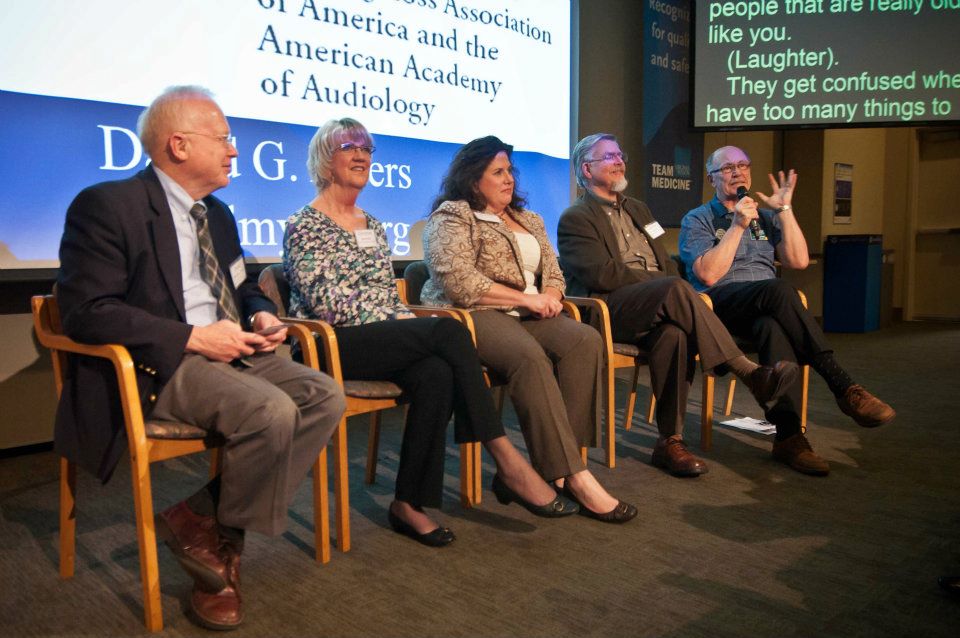
Just one meeting – that’s all I’m asking. Try an information seminar, or go to a monthly meeting of a local hearing loss group. Better yet, go to a conference where you may possibly have the time of your life. Just once, try it.
And why should you do this? Well, on the practical side, you will leave the seminar or conference with a better understanding of how modern hearing technology can connect you to anything – your TV, your car, your phone, or your beloved. You’ll learn neat communication strategies to use at work or in social situations. And you will discover that PWHL are not a homogeneous group of needy people; we’re really just members of the general population with technical issues and a habit of saying ‘what’ a lot.
But those are peanut-sized benefits compared to the big one: you will come away with a new sense of your hearing loss, an attitude shift that may be subtle or dramatic. You’ll experience either a warm positive glow, or the feeling you’ve been slugged with a golden sledgehammer. And both of these are good signs.
When you get home, your family will notice something different about you. They won’t be able to put their finger on it – but they’re thinking maybe something about the eyes and they will be right. Your eyes aren’t crazed, just a little shiny, glittering with the passion of the newly converted. You left the house frustrated with your hearing challenges, and have come home with a new sense of, “I have hearing loss – and hooray, that’s OK!”
It’s very liberating. I know, because it happened to me.
After the closing banquet of my first PWHL conference, about 12 of us went to a pub. We were looking for a place that had room to accommodate our group, and was quiet enough to allow us to communicate. A few places were assessed and rejected – too dark, too loud, busy, bad décor – before the group found a suitable, almost empty place, with only one other occupied table, a quartet of ‘hearing’ people sitting in the corner.
I will admit this: 12 hard of hearing people are loud. We talked loudly and laughed louder; our conversation was punctuated with frequent cries of ‘What did you say?! What did she say?!” I was embarrassed and even cringed at the annoyed looks coming from the ‘hearing’ people.
But then came that crystal-clear, life-changing moment. I thought, “So WHAT if we’re loud? We’re smart and funny, we’re paying for our beer, and this is how we communicate!”
That night I learned – I really got – that there’s no shame in hearing loss. (I also learned that small groups of PWHL work best in a pub.) But my outstanding take-away from the conference was a new perspective, the sense of normalcy about hearing loss that isn’t easy to absorb through the written word, either online or in articles. This was news to me – the understanding that I am just one of many people who are dealing with a challenging issue as we go about our lives.
Since that first Canadian Hard of Hearing Association conference, I’ve attended events around the continent, frequently as an invited speaker. I’ve met what seems like thousands of people, inspirational, provocative, compassionate and interesting people, who help each other along the road to becoming knowledgeable PWHL. Some have become close friends, and I look forward to seeing them each year at the one event where I can truly relax, knowing that my communication needs will be both understand and met.
In 2013, there are several national consumer national conferences that you should consider:
• Hearing Loss Association of America (HLAA) – Portland, OR, June 27-30
• Canadian Hard of Hearing Association (CHHA) – Edmonton, AB, May 23-25
• Say What Club (SWC) – Williamsburg, VA, May 15-18
• Association of Late Deafened Adults (ALDA, Joint Conference with TDI) – Albuquerque, NM, October 16-20
• Association of Medical Professionals with Hearing Losses (AMPHL) – Austin TX, April 5-7
I will be speaking at the first three (HLAA, CHHA, and SWC), so come and meet me there – maybe we can inspire each other. Make it your annual holiday. The conferences offer fabulous bang for the buck, but if you’re looking to cut costs, consider sharing a room; stretch your food money by popping buns from the buffet table into your pocket for breakfast. The excursions are great, but the best stuff happens at the conference – the workshops, informal social events, the exhibition of technical devices and simply talking to other PWHL and soaking up a world of experience.
But if you don’t have a spare three days, check out information seminars and association meetings in your local community and state or province. Ask your audiologist or hearing instrument specialist about where to go, and then take him or her along with you. (Professionals can always stand to learn a little something from the people they serve.)
That’s my pitch for why PWHL should meet other PWHL….hope to see you somewhere this year!
This article is originally published in Hearing Health & Technology Matters.
For more blogs by Gael Hannan, please visit: http://hearinghealthmatters.org/betterhearingconsumer/




 letsloopseattle