New Loops in Everett and Mercer Island

Just a quick update to let everyone know that the Everett Public Library and the Everett Senior Center recently installed induction loops to the deep appreciation of their guests and members.

The Stroum Jewish Community Center on Mercer Island is also now looped, offering public space and events for everyone, regardless of their ability to hear.

If you are in Everett or Mercer Island, be sure to check out these great new looped spaces!

For a full listing of hearing-loop equipped locations in Washington, be sure to view our “Loops in Washington” page.

Posted in Uncategorized | 4 Comments

Did you say “Pecha Kucha”?

“Could you give a ‘pecha kucha’ talk?” Say what!?
That’s what Charlie Rathbun, Arts Program manager of 4Culture, asked me when he invited me to participate in Washington’s Cultural Congress, a statewide, collaborative event that brought together a diverse group of cultural leaders to strengthen skills, form new partnerships, and to learn from each other. This year’s congress had a special focus on using the arts to create social change. 

A Pecha Kucha talk is a 7-minute speech about any topic, similar to a TED talk. At the cultural congress last week, I had the opportunity to talk about hearing loss, hearing access, and how the arts community in Washington can help open the doors for all audiences to participate and enjoy the arts. For the talks, I installed a temporary hearing loop in Seattle Center’s Rainier Room. A group of generous volunteers helped me tape down the “squared snowman loop”, designed by Hearing Loops Northwest. We powered the loop with a Univox 700, which we then connected to Seattle Center’s excellent sound system.

Many people shared that they had never spent much time thinking about hearing loss, hearing loss technology, or how hearing loss would impact one’s enjoyment of the arts. Being at the congress made them think more about how important it is to ensure everyone can participate in the arts. Many at the event tried on headsets, and learned what it was like to use assistive listening device. They also tesed out hearing through a hearing loop—there were smiles all around the room as people experienced the clarity of the hearing loop and the telecoil receiver. It was such a cool experience to see artists, teachers, performers, cultural & civic leaders all interested to learn about hearing loss & hearing technologies. After the conference, Pamela Lavitt of the Stroum Jewish Community Center, told me that she was so inspired by what she had learned and experienced at the congress, that she was going to change her 4culture equiptment grant to include hearing loops!

During another part of the conference, the Round Robin, many saw first-hand just how difficult hearing can be for those of us with hearing loss—many people voiced difficulty hearing the different speakers in an acoustically challenging environment. Clearly it can be a challenge for everyone to hear and be understood when multiple people are talking in close proximity, which makes it that much more important that we focus on making spaces accessible for all hearing levels.

It was a huge honor to present with savvy cultural and social change makers of the Pacific Northwest! No two talks were alike; though most were punctuated with rapid fire dialogue. It was suggested that next year, speakers be sent a video to help plan their pecha kucha. Did I deliver a perfect 7 minute pecha kucha? Well, not exactly. But I did get the conversation started; Washington arts communities are getting in the loop.

I want to give a special thanks to all the speakers and everyone at 4culture, Washington State Arts Alliance, and Seattle Center for your interest and support.

Posted in Uncategorized | Leave a comment

Katherine Bouton in the Loop at Town Hall & Bellevue Arts Museum

When I learned Katherine Bouton would be coming to Seattle to promote a book she had just written about hearing loss, I got busy. I knew that this gifted, well-known author and former New York Times book editor would draw a crowd. Her personal stories would get Seattle talking about hearing loss. When Katherine reached out to us at HLA-WA, we arranged for her events to be fully hearing accessible, excited that so many people would be able to experience hearing accessible events.

Hearing Accessible

Book tours and author readings are not held in hearing friendly venues. Keenly aware of how disappointing it is to attend an event and not be able to hear, and afterward, not be able to contribute to meaningful follow-up discussion, Katherine wanted to be sure everyone who came would be able to hear and participate. She requested assistive technology so all who attended would be able to do just that. She wanted a hearing accessible venue. Town Hall listened and Spencer Norby of Hearing Loops NW volunteered to install a temporary Hearing Loop for the event.

Katherine has experienced using a hearing loop; yet, the thrill of hearing clear, intelligible speech easily, is remarkable and empowering. This would be the first time she had given a Looped presentation where could hear and interact with the audience through the hearing loop.

Hear It Your Way

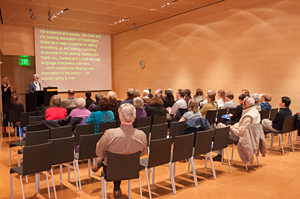
Katherine Bouton reads at the Bellevue Arts Museum with CART Captioning behind her.

Katherine Bouton reads at the Bellevue Arts Museum with CART Captioning behind her.

We arranged a HEAR HERE program format, which included a hearing loop, real time captioning, and an ASL interpreter. This trio of accommodations is essential to ensure all people and all degrees of hearing loss can have clear understanding. Hearing loss is a spectrum; there is no single solution that will accommodate everyone in every environment.  This was truly a hearing accessible event!

Katherine Bouton’s reading of Shouting Won’t Help, Why I and 50 Million Americans Can’t Hear You drew over a hundred people at the downstairs Town Hall venue. To a full house, Katherine shared her secrets and told a story many might call their own. Too busy living, stunned by the stigma, she, like so many, allowed her pride to get in the way of taking care of herself. Unaware of what she was missing, mingled with denial and shame, she dismissed the severity of the problem as she bluffed colleagues and strategized to keep the secret.

Coming Out

CART Captioning at the Bellevue Arts Museum.

CART Captioning at the Bellevue Arts Museum.

The reading at the Bellevue Arts Museum looped auditorium was smaller and more intimate. In both talks, Katherine was open and genuine as she revealed how difficult hearing loss had been for her, largely because of her own inability to come to terms with it. Katherine explains that she spent years at The New York Times trying to hide her hearing loss. Her denial, combined with the associated stigma, kept her from asking for the help that she needed, and led her to withdraw from her life at her job, with her friends, in our busy—and noisy—world. She realizes now, that everyone would have helped—all she had to do was to ask.

Self-denial, lack of peer support, and fear of rejection was what Katherine kept coming back to, and one that many with hearing loss experience. Because hearing loss is silent and invisible, because it’s associated with old age, because people don’t want to be different or to ask for special accommodations—many with hearing loss suffer in self-denial and silence, cutting themselves off from the world.

This made me think of a post of Penelope Trunk’s on asking for help. What struck me as so relevant to Katherine’s story, are the first and second points that Penelope makes:

  1. Remember that people like to help. It feels good if it’s a defined task.
  2. Ask for help when you need it, regardless of when people typically need it.

Katherine describes the relief she felt when she finally came out to reveal her hearing loss. She was able to ask for, and receive, the help that she needed in order to hear. Remember, to ask for the help you need, when you need it.

Read Katherine’s fascinating and insightful book: Shouting Won’t Help, Why 50 Million Americans Can’t Hear You. Then pack it in your suitcase as you head to the Convention, where this hearing loss celebrity advocate will personally autograph your very own copy.

To learn more about Katherine Bouton, and to learn about her upcoming events, visit her website: www.katherinebouton.com.

All photos taken by Miguel Edwards: http://migueledwardsphotography.com/.

Posted in Uncategorized | 1 Comment

Katherine Bouton Visits Seattle

Post from HLA-WA President Karen Utter.

Dear friends,

Katherine Bouton, New York Times former columnist and author, is in Seattle this week. Last night she did a reading that the Downstairs Town Hall auditorium in Seattle based on her new book; Shouting Won’t Help and Why 50 Million Americans Can’t Hear You. HLA-WA with the organizational leadership from Cheri Perazzoli assisted by Hearing Loops Northwest sponsored the CART, temporary room loop and ALDs, plus sign language interpreters that were used for the presentation. We had expected maybe 50 would attend. Lo and behold on a rainy ‘n dark Seattle evening there were over a hundred people present for the program. The room was nearly at capacity. It was a broad range of attendees with all degrees of hearing loss and deafness represented among many hearing people that were in attendance. The program was very well received and all hearing accommodations worked beautifully together.

There will be another fully hearing accessible program Friday evening at 6:30 at the Bellevue Arts Museum. This program is being offered for free. Seating is limited; please RSVP to Bellevue Arts Museum.

If you wish more information on Katherine Bouton or her book please see:

Karen Utter, HLA-WA President

Posted in Uncategorized | Leave a comment

HEAR HERE: Accessible Communities for All

PNACheriIntro_2

Lee Harper, Executive Director of PNA, asks Cheri Perazzoli, Lets Loop Seattle, to describe the Hearing Loop.

Let’s loop Seattle was thrilled to have a role in the special community program on accessibility that the Phinney Neighborhood Association (PNA) held last weekend at the historic Phinney Ridge Blue Building. What better time to introduce our HEAR HERE format than during a program focusing on accessibility?

According to Patrick Dunn, PNA Program Director, the recently installed elevator inspired the accessibility program to bring the community together to celebrate improved access and examine what attributes are needed to create an accessible community.

The community event was planned to take place on the newly accessible 2nd floor wheelchair, but what about hearing access? We wanted to ensure that we were including and engaging all audience members.

hearingtinyWhy is Hearing Access Important?

Hearing loss is an invisible disability that impacts daily communication for 1 of 7 Americans and increases to 1 in 3 at age 65. Hearing loss is a daily challenge that those with normal hearing find difficult to understand. Keeping up with conversations when you can no longer hear consonants make every verbal exchange in a noisy room a brain teaser work out.

Even the most sophisticated hearing aids cannot separate important sounds from back ground noises.

How do communities provide hearing access?

Technology helps hearing aids work better. We set up two completely different types of technology to demonstrate effective communication access.

  • Hearing Loop Technology TCoil Logo
    For the accessible program, Spencer Norby of Hearing Loops Northwest installed a Portable Loop. In this vintage wood floor classroom, a simple perimeter loop laid around the room was more than adequate.
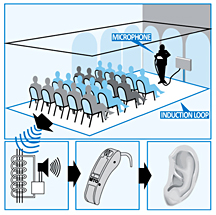
    how_induction_loops_work_TinyLMicrophones are key to making this technology work; a presenter speaks into the microphone and clear sound is delivered directly to the T coil located in the hearing aid. One simply pushes a button to access the T coil Program. Background noise is eliminated and the user is able to understand words clearly, as will anyone else with hearing aids or cochlear implants. Those who need hearing help who do don’t have hearing aids will benefit by wearing a loop receiver and headset. Hearing loops enhance sound to provide a full listening experience.
  • CART Technology
    cart2_Stanely

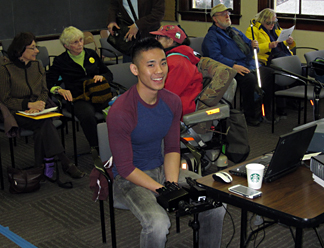
    Stanley Sakai, providing CART captions for the event.

    Most are familiar with captions on the TV screen, but are surprised to learn about real time captioning or Communications Access Real time (CART). We are veryappreciative to Stanley Sakai who wowed us with his CART skills, providing captions along with all of the speakers at the event. CART may be provided in the classroom, at meetings, workshops and other presentations.

Accessible Communities for ALL

Room’s Ready Let’s GO!
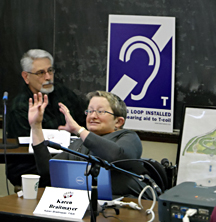
KarenBraitmayerPic_2Karen Braitmayer, Seattle’s Star of the US access board, uses innovative design solutions to break down barriers to access, to create environments that are welcoming to all.

Karen opened this visionary discussion with a simple question: “Would anyone like a verbal description of the slides”? The affirmative reply instantly directed our focus to develop interactive and inclusive conversation with the whole group.

Karen introduced us to the concept of Universal Design: the design of products and environments to be usable by all people, to the greatest extent possible, without the need for adaptation or specialized design, and more specifically took us through the Seven Elements of Universal Design.

Karen shared with us that she personally defines accessibility in terms of easy access and ease of “visitibility”. She directs us through the neighborhood pointing to homes with a big welcome mat; homes that feature step less front door entries. Homes that are easy to navigate are welcoming and invite visitability.

Karen emphasized just how critical universal design is. Facilities that are designed to be welcoming and visitable by all different types of people in our communities, will, in fact, be visited and used by all people. Design Matters.
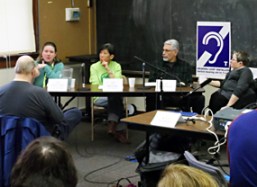
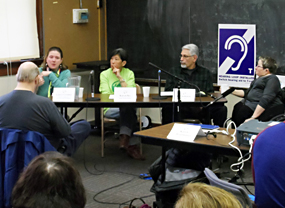
1_PNAPannel2After Karen’s engaging presentation on Universal Design, we moved to a panel discussion, with Karen Ko, Ed Mederios, and Laura Gramer.

Karen Ko’s presentation invited us to imagine a sensory garden within Woodland Park that would be accessible to all ages and abilities. Plants and all garden elements are being designed provide sensory experiences unique to the garden. Raised beds and tall plants enhance and stimulate our senses, providing the ultimate garden experience.

Ed Mederios shared the benefits of volunteering within the village, the efforts to create and nurture a culture of community cooperation. Age does not define ability.
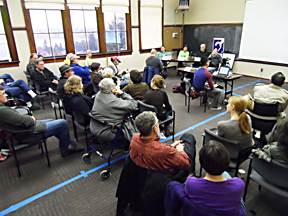
wholepanelLaura Gramer inspired us with updates of her work with the Seattle Commission for people with disabilities. Laura has developed and fostered relationships with city leaders. She’s worked to amplify the message that access to the tools to break down barriers in communication, employment, and civic access are lacking. Her work with the education committee has strengthened the city’s Emergency Management program. Laura continues to promote accessible travel with Open Doors.

Throughout the day, we kept returning to this central question:
How can our communities best provide effective communication access within our neighborhoods?

Design Matters

Hearing loops have the potential to be the most useful and practical solution for hearing in acoustically challenging environments. Direct hearing aid access to clear and effective communication empowers the user by letting them choose how they want to hear. It’s clean, unnoticeable, affordable, and easy to use. By integrating hearing loops in our auditoriums, boardrooms, theaters, museums, transport kiosks, transportation vehicles and retail counters, as they are throughout northern Europe, we can make a difference every day for those with hearing loss. We can change the culture and eradicate the stigma of hearing loss.

Inspired contemporary design for presentations could include a room designed specifically to accommodate two screens for easy CART Access. Software can be implemented to incorporate captions at the top of power point presentations to optimize Cart

Design Matters

People of all ages benefit from accessible features and customer service practices.  Accessibility makes a visit to the market, a theater performance, and an internet search easier, and much more enjoyable for people who experience limitations in vision, hearing, mobility or memory. Older individuals are more likely to use accessible features if they are integrated in to the overall design of the building, publication or website.

2013 was designated the year of sharing by PNA. Let’s join them.

 Share the sound; let’s loop Seattle!

Posted in Uncategorized | 1 Comment